There are 104 lighthouses along the shore of Lake Michigan. I have no mania to see ALL of them, but Vicki and I look forward to a good sampling.
We begin our tour in Michigan City, Indiana, with the East Pierhead Light and the nearby museum.
Elevated walkways like this one at Michigan City was used by the lighthouse keepers when storms left the pier awash.A bit of rust calls out for some maintenance work at Michigan City’s lighthouse.We got to walk out the pier to the Michigan City lighthouse, but couldn’t go inside. 😦It’s a good thing I learned to navigate spiral staircases while working at the old Arkansas Democrat building in the 1970s. The one from the newsroom to the composing room was a bit roomier than this one, however. I suspect every lighthouse we visit will have at least one spiral staircase. This one is to the reconstructed light room that was above the building that is now the museum.
But the lighthouse itself was not open for tours, which was a bit of a disappointment. It’s a decent hike out to the pier, which I made with Grant, a Canadian R-Pod owner we met at the Forest River Owners Group rally in Goshen.
A number of things drive my interest in lighthouses and our plans for this loop.
1. Technology and Tragedy
When I first read “A Short Bright Flash: Augustin Fresnel and the Birth of the Modern Lighthouse” by Theresa Levitt, I was amazed by the technological changes that spanned the age of sail and steam up to to modern shipping and satellite navigation.
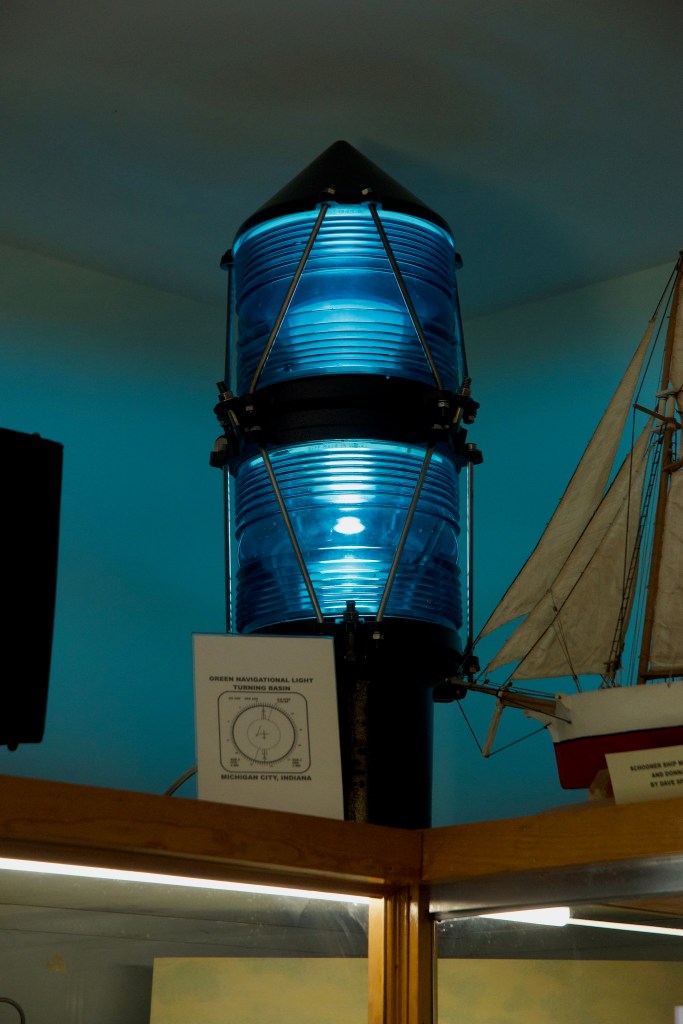
This 4th order Fresnel lens used at the Michigan City lighthouse was manufactured in 1892 by the Barbier, Bernard & Turenne company in France. The lenses are classified by “order,” and this one is close to three feet tall. A 1st-order lens is more than eight feet tall.Tucked away behind a desk is a figurine of Augustin Fresnel, the French physicist who developed and promoted the Fresnel lens. It seemed a bit unfair that he should have such a small presence in the museum.The Frenel lens inspired a whole range of similar lenses that help focus light in a horizontal beam. It’s even behind that plastic magnifier that us old folks use to enlarge a page of text.
Going to sea has always been a dangerous venture. “Here Be Dragons” aside, the real danger is coming home in a storm or at night to a rocky coast. The wreck of the Edmund Fitzgerald is only the most famous of hundreds of shipwrecks in the Great Lakes. The capsizing of the SS Eastland excursion ship was the deadliest, with 844 people dying when the ship rolled to its side while tied to the dock before a planned trip to Michigan City.
One reference at the museum said 30,000 people have died in the Great Lakes.
The Edmund Fitzgerald sinking is famous throughout the Great Lakes, but it is only 29 of about 30,000 who have died on the lakes. It’s a dangerous place out there.The map of shipwrecks is another reminder of how dangerous the lake can be.All hands were saved from the 1898 wreck of the steamer Horace A Tuttle by the Life Saving crew at Michigan City.The Eastland Disaster was the worst loss of life in the Great Lakes, with 844 lost when an excursion boat capsized while tied to the dock in Chicago. The excursion was bound for Michigan City.
The Fresnel lens, which was able to focus the beam from a simple oil lamp so that it could be seen miles and miles from shore, was a true lifesaver, at sea and on the lakes.
After decades of service, the Fresnel lenses have been retired and put on display in museums, replaced by brighter LED lights and satellite navigation. They are things of beauty, highly polished pure glass that illuminate our history.
I confess I have a hard time imagining an LED lighthouse beacon drawing me to a future museum.
2. Rescue from the Deep
The official motto of the U.S. Coast Guard is “Semper Paratus,” or Always Ready. An unofficial one, which may strike deeper, says “You have to go out; you don’t have to come back.”
The official motto of the U.S. Coast Guard is “Semper Paratus,” or Always Ready. The unofficial motto is, I believe, “You have to go out; you don’t have to come back.” I try but I can’t really imagine what it would take to go out in a storm on the Great Lakes in one of these, rowing out to rescue the crew or passengers of a wrecked vessel.Thomas J. Armstrong was the head keeper of the Michigan City lighthouse. He and his wife, Jessie, had movie star good looks, if only motion pictures were much of a thing when they started work in 1904.After the sinking of the USS Huron https://archaeology.ncdcr.gov/uab/heritage-dive-sites/huron , Thomas Nast drew this cartoon. ”I suppose I must spend a little on life-saving service, life-boat stations, life-boats, surf-boats, etc.; but it is too bad to be obliged to waste so much money” / Harper’s Weekly, downloaded from Wikipedia, which identifies the cartoon as being in the public domain
That sentiment was present in the Coast Guard’s predecessor, the U.S. Life-Saving Service, largely volunteers who manned surf boats to assist in rescues from wrecks close to shore.
I try to imagine what it would be like to go out in a storm, whether on a modern Coast Guard Motor Life Boat or pulling at the oars of a 25-foot wooden surfboat. I can’t say that I have what it takes to do that.
But these little boats go out all the time to aid people in distress.
I take my hat off for them.
3. Remembering the history
Vicki and I love small-town museums. The one in Michigan City is different from every other such museum, while being much the same.
It had an amazing number of handcrafted ship models, from Lord Nelson’s HMS Victorious to a World War I subchaser. There is a display talking about the Hoosier Slide, a sand dune famous for industrial uses as well as a tourist and wedding destination of the day.
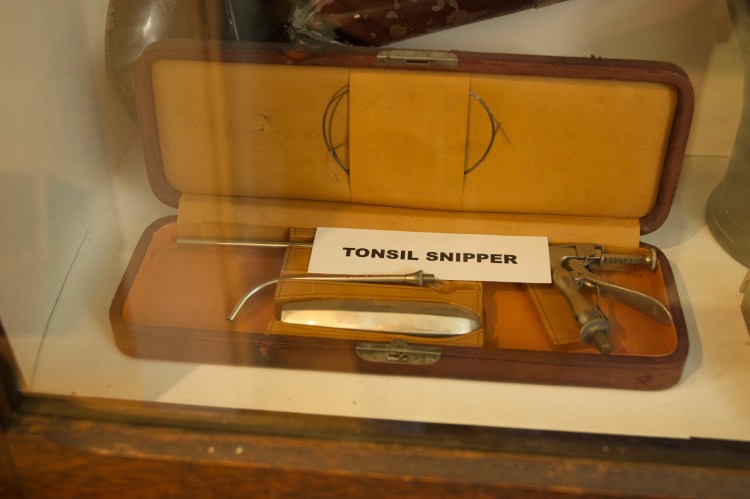
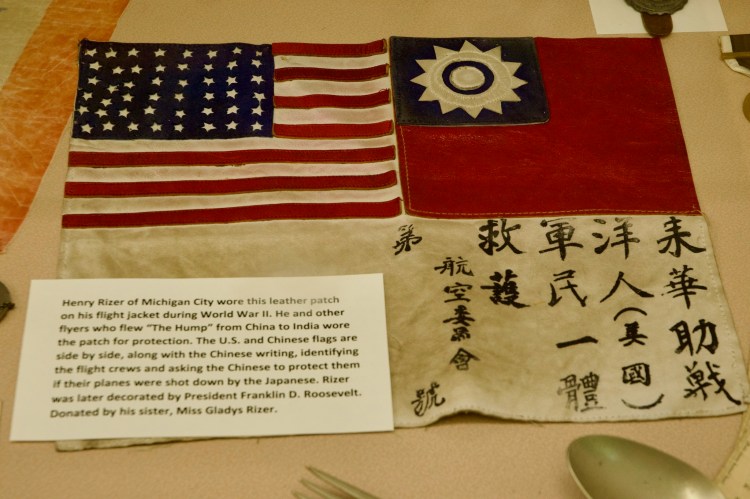
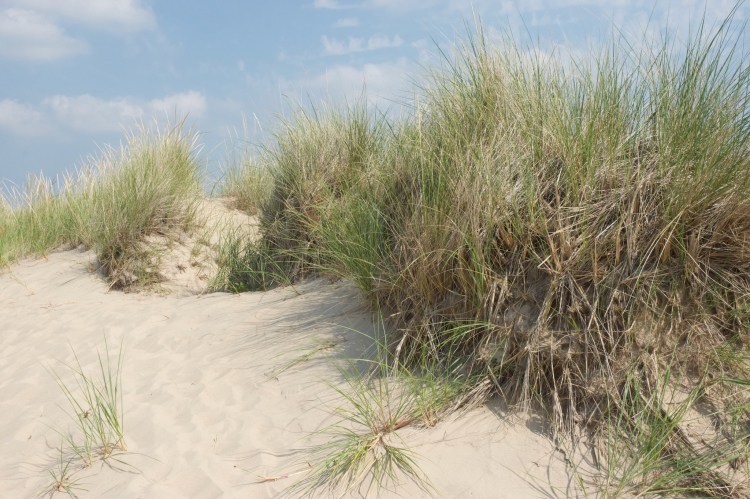
President Abraham Lincoln’s funeral train passed through Michigan City on his way to burial.Could it be that in the cold northern winters, there is not much to do but build elaborate models of famous ships? Could be. This is the HMS Endeavour, used by James Cook during his voyage to the South Seas and Australia in 1770.Like all small museums, this one has a collection of the quirky technology of the past, such as a tonsil snipper. I’ll take mine with some ether, please, doc.Local history is shared and passed down at these museums.Lake steamers were a big business back before World War I, bringing cargo and travelers from Chicago to Michigan City and other ports on Lake Michigan.No idea what the Yo-Ho Club was about, but I suspect it was a lot of fun. Or maybe a lot of trouble.Beaches all look the same, but every one is different, too. This one is at Michigan City.A juvenile Sanderling shorebird takes a walk along the pier. The adults turn a rusty brown on top.The Chicago skyline is somewhere out there in the center of this photo. I could barely make out some shapes with the naked eye, but the camera wasn’t up to the task. All of our photos of the lake were obscured by smoke from the Canadian wildfires. It looked like a fogbank just offshore.
And so it begins. I promise to keep up with the lighthouses as we see them, and to backtrack on some of the cool places we saw earlier but that didn’t get a blog post.








 Two Sheeps to the Wind
Super interesting and fun to share in this experience.
LikeLike
Yo Ho, A pirates life for me!
LikeLike