Visiting the Cahokia Mounds east of St. Louis can be a sobering experience.
A millennium ago, the mound-building peoples of Illinois and Missouri had a flourishing culture that dominated the area, and the landscape, with the largest earthen mounds ever built in the Americas and a population that perhaps reached 20,000 people.

What we call Monks Mound, the largest mound, required about 22 million cubic feet of earth, dug from nearby pits and carried on workers’ backs in baskets. There were at least 120 more mounds, much smaller, built in the area.
Nothing beside remains.
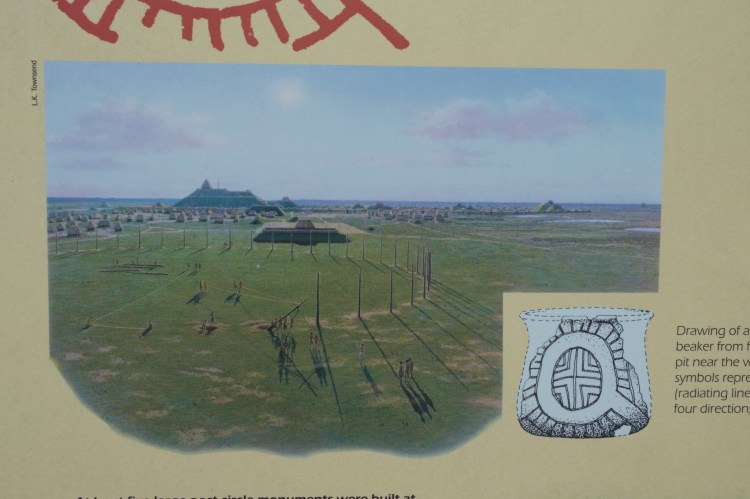
Woodhenge, a series of the astronomical calendars built to tell the seasons, has been reconstructed based on evidence of where the postholes were.
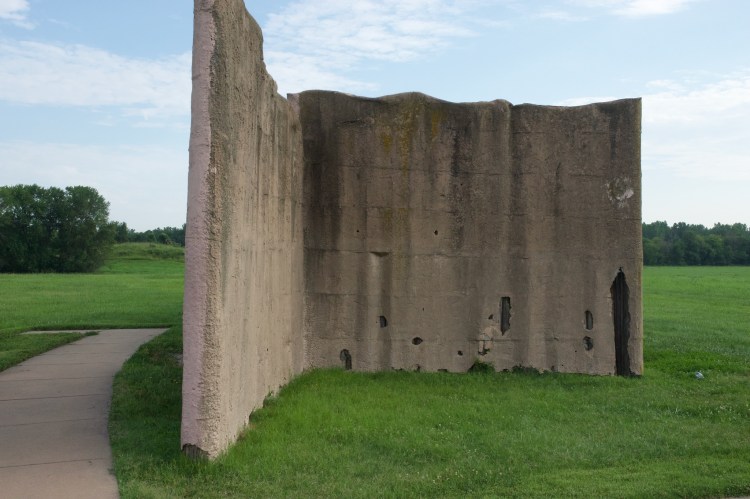
The stockade, built as the civilization was fading, is also known only through the remnants of the holes where 15,000 to 20,000 logs were used.
Even the name of the people, Cahokia, comes from one of the tribes of the Illiniwek confederacy of native peoples encountered by Europeans. The Illiniwek didn’t arrive in the area until 400 years after the mound builders were gone.


For me, the drive into the area was a sobering experience in itself. Vicki noticed numerous burned-out buildings, what I call the broken teeth of a community. The prevalent businesses seemed to be girlie shows and liquor stores. Even the visitor center for this park, which is a World Heritage Site, has been closed for repair for more than a year.
Nevertheless, I’m glad Vicki and I drove the hour from our campsite to see the mounds. They stand as a reminder for what humans can accomplish as a community, as well as the transience of our accomplishments.
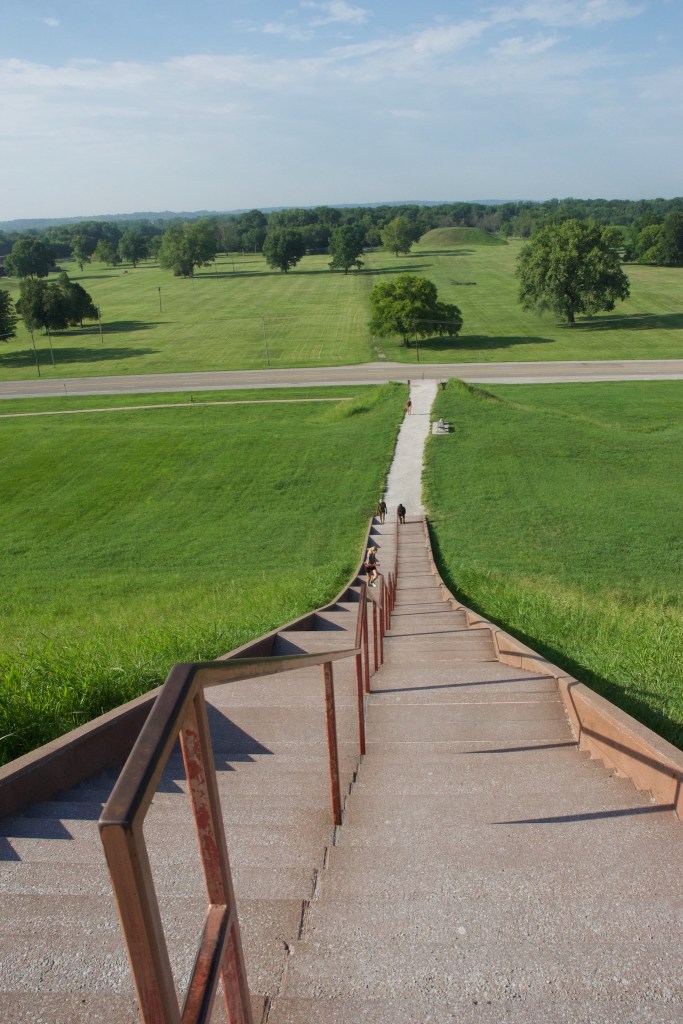
One of our goals was to climb the 156 stairs to the top of Monks Mound (named for the French Trappist missionaries who lived nearby in the early 1800s). Vicki inspired me to make the climb twice, and I succeeded. I got my heart rate up to at least 128, which is tough to do in flat campgrounds. I talked to one guy making the climb, and he said his friend runs a mile then climbs up and down the mound until he reaches a second mile. That’s quite an achievement, I say.

 Two Sheeps to the Wind
Very interesting!
LikeLike
Dear friend, so great to see your beautiful pictures and to read deeper informations. Hope Vicki and you have fun all the time and post more. I´m sitting in homeoffice and your blog is making me dreaming. Thank you so much! Rita-Tank from Germany
LikeLiked by 1 person