I have a thing for airplanes, especially military airplanes, and especially World War II planes.
Vicki accepts this, but she does not share it. So when I wanted to visit the No. 1 British Flying Training School in Terrell, Texas, I enlisted a couple of grandkids.
One surprising lesson for me from this small-town museum near Dallas is that the American Lend-Lease Act was more than just sending a bunch of old destroyers to England to help protect the Atlantic convoys in the war. We also set up seven training schools for British pilots.
These schools were in Texas, Oklahoma, Arizona, California and Florida, where the weather was generally good for flying and the only other planes in the sky were friendlies.


This museum is, by design, a tribute to the more than 2,000 cadets who trained there, as well as a recognition of how the town came together to welcome and support those young men from overseas.
The only airplane at the site when we visited is a BAC Jet Provost, an RAF trainer that didn’t enter production until the mid-1950s, long after the last English cadet left Terrell. The docent at the museum said the Provost, now sitting on the flight line outside the museum proper, is being restored for use as a static display at some point.

The museum itself has photos of the cadets during training and having fun in town, at places like Hall Drug.
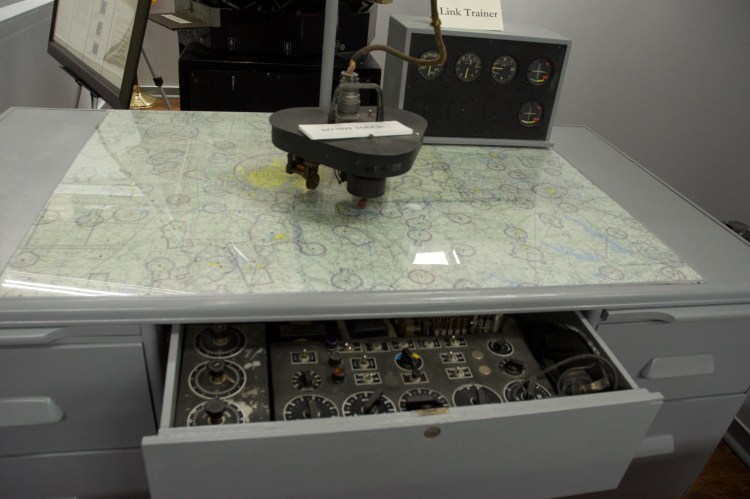
There is a Link Trainer, an early version of a flight simulator that was used to introduce pilots to instrument flying.


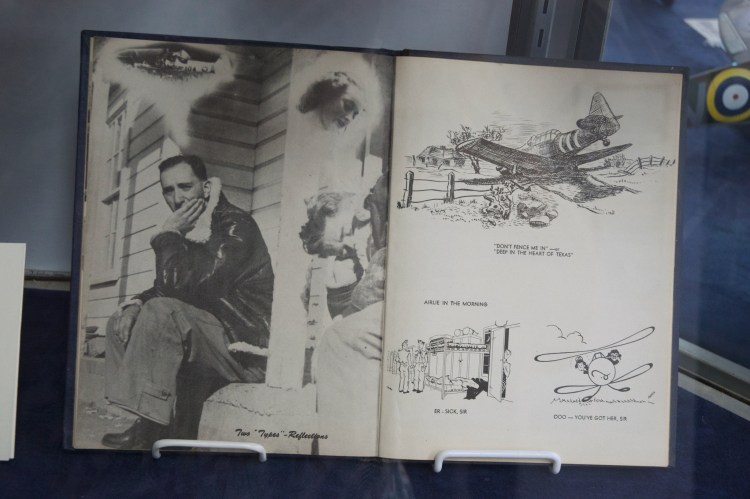
The small gift shop has a number of books, two of which I purchased.
One, “Terrell Tales,” is a pamphlet published by the museum giving stories of training “told by students, instructors and friends.”
My favorite tells of a former Glasgow policeman, Jimmy “Jock” Mason, who became disoriented while practicing aerobatics in a PT-17 Stearman trainer and landed in an open field to get directions back to base. One of the locals asked where he was from. “A’m frae Glesga, Scotland,” Jock replied. “Jeez. That’s a helluva way in that little plane!” The cadet recounting the story says Jock swore it was true.
A common theme among the accounts is the kindness shown by the people of Terrell to these young men who left a war zone half a world away to engage in their own version of danger. They were welcomed into the hearts and homes of the Americans.

The other book, “The Royal Air Force in Texas” by historian Tom Killebrew, points out just how serious and dangerous the early part of the war was for pilots who completed their training. While many records have been lost, researchers have looked at survival rates for two of the courses of training. For Course 4 in Terrell, of 33 who transferred from the British Army for flight training, only seven survived the war. And of the 38 graduates of Course 3, only 14 survived.
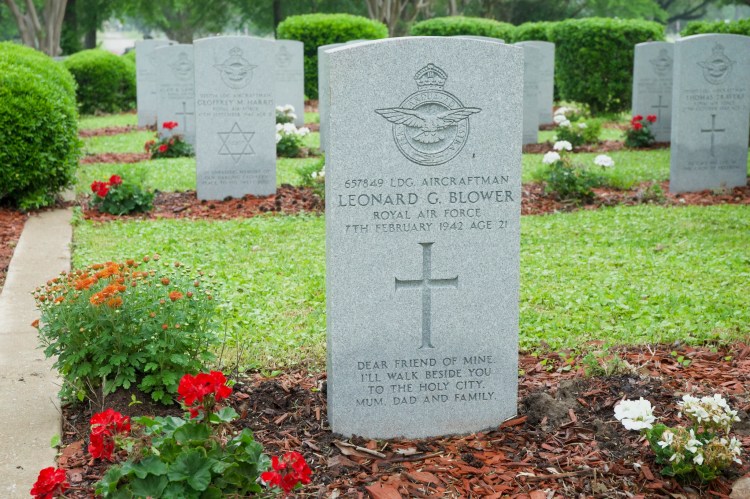
Not far from the museum is a reminder of how dangerous training itself could be. British soldiers who die while serving overseas are buried in that area. As the World War I poet described it, “there’s some corner of a foreign field that is forever England.”

Twenty British cadets are buried in Oakland Memorial Cemetery in Terrell. Of those, 19 were in flying accidents; the other died of tuberculosis.
Eighteen headstones carry Christian crosses; one has the Jewish Star of David. The last is the grave of an agnostic, according to Killebrew’s book, and has no religious symbols. I can only assume that the cadet’s parents were people of faith, since the marker bears the words “God’s greatest gift / Remembrance.”

Both books give the lyrics of a song, attributed to Flight Lieutenant M.W. Palmer, “We’re the boys of No. 1 BFTS.”
The last verse offers a nice parting thought from those airmen who went home to finish the fight of World War II.
We’re the Boys of No. 1 BFTS
And our very grateful thanks we must express;
For though we’re now in clover it will very soon be over,
We shall see the Cliffs of Dover and be clearing up the mess;
But when we’ve finished off the War and seen it through
We shall think of Terrell, Texas, and of you;
And though sea and sky may hide you they never can divide you
From the Boys of No. 1 BFTS
Oh yes!
The British Boys of 1 BFTS.
 Two Sheeps to the Wind
That sounds like an interesting visit! I think Pat would have enjoyed it as well!
LikeLike