A love of history is a big part of why we travel. No, it’s a respect for history, a recognition of how important it is to understanding who we are and what we stand for and what we strive for, as individuals and as a nation.

We ignore history, or forget it, or suppress it, at our great peril.
Yet the state of Texas and the town of Gainesville pretty much did just that for more than a century after the Civil War.
In October 1862, a mob of Texans — frightened by Indians, by abolitionists and by their fellow Texans who happened to still support the Union after the start of the Civil War — formed a “Citizen’s Court” and started hanging their white neighbors.
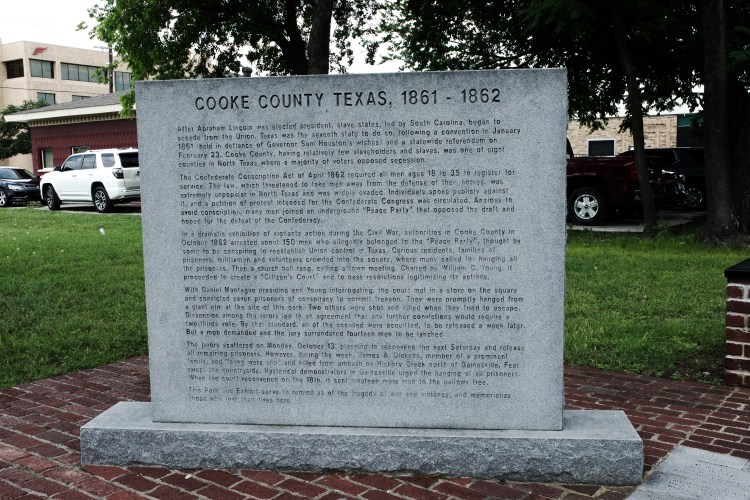

By the time it was over, 40 people had been lynched and another two shot while trying to escape. Those weren’t the only hangings in the state. Among them was one woman, a Mrs. Hillier, who was lynched elsewhere because her husband was a Confederate draft-dodger.
These events were quickly forgotten or hidden in Texas. The records of the kangaroo court disappeared by the 1920s; the written accounts from people involved were filed away and not published, and the first monument erected at the site reflected only the fears of the mob. Descendants of some of the survivors finally got a more accurate monument erected in 2014.


I had never heard of the Great Hanging of Gainesville before moving to Texas and starting to read the Texas Observer, where I found a story by Abby Rapoport (https://www.texasobserver.org/great-hanging-gainesville/). That led to a visit with Vicki to Gainesville and to the purchase of “Tainted Breeze, The Great Hanging at Gainesville, Texas, 1862” by Richard B. McCaslin.
McCaslin is mentioned frequently in the Observer article. One quote I found particularly meaningful.
“There’s a national message to what happened here,” he said. “People need to know what the Civil War was really like. It wasn’t Gone with the Wind. We were just as ugly to each other as other countries that get pulled apart in civil wars. It’s part of us, it’s part of who we are, and we need to think about that and make damn sure it doesn’t happen again.”
There is a movement afoot in this country to sanitize the history of slavery and race relations. I firmly believe this is a bad idea.
America needs to look at its history with both eyes wide open. There’s a lot of good to see and celebrate. There is a significant part in which we missed the mark of the founders’ lofty goals; we need to learn from that.
I have spent a lot of time considering my own ancestors. All four of my great-grandfathers fought for the Confederacy. I’m interested in that because, for the most part, it’s the one time my ancestors took part in something larger than the average life of a farmer.
At least one of those ancestors was a slaveholder.
I would much rather that they be on the right side of history and of justice, but I feel sorrow, not shame. And it’s really hard for me to imagine any teacher in any region trying to shame students for what their ancestors did.
That reeks of the “blood libel” that has been used against the Jewish diaspora for centuries.
I may feel sorrow for what my ancestors did. But I carry no responsibility for their actions. I have accountability only for my own.
Further, I don’t even judge them. They were products of their time, a time that allowed slavery to exist. Had I been born in that place and time, I can only hope that I would have taken another path. I have no illusions that I am better in some way and would have done so.
One other point that I feel I must make. In no way do I think that the Great Hanging of Gainesville was somehow worse because the victims were white. We still have a goal of traveling the Civil Rights Trail to witness the actions taken against fellow humans who happened to be descended from Africa instead of Europe.
Civilization is said to be a thin veneer on a brutal world. That’s a lie. Sometimes it’s a whitewash that barely hides our inhumanity to each other.
 Two Sheeps to the Wind
Powerful, Phil. I, too, was unaware of this history, although I’ve been to and through Gainesville many times. I agree with your perspective.
LikeLike