Built: 1870 … Height: 36 feet … Lens: 5th order Fresnel (now on display)
“I can think of no other edifice constructed by man as altruistic as a lighthouse. They exist only to serve.” — George Bernard Shaw, quoted on the website for this lighthouse
The Mission Point Lighthouse stands at the tip of the peninsula that juts out into Grand Traverse Bay in the “mitten” of lower Michigan. Traverse City (pronounced like Col. Travers of the Alamo) was named because traders discovered it was far better to carry their canoes and goods across the base of the peninsula rather than paddle all the way up the east side and back down the west.
These lighthouses are not in the order in which we visited them. Just FYI.
The Mission Point Lighthouse is at the tip of the Old Mission Peninsula, which extends north from Traverse City.
(Vicki says I should point out that the pronunciation is not the “tra-VERSE” that I have used, but the “TRA-vers,” which sounds to me like Col. Travers of the Alamo. She also wants an explanation of the Fresnel name for the lenses used on lighthouses since French physicist Augustin Fresnel developed the idea in the 180os. As you might guess, it’s a French name with a silent “s” in the middle. So it’s like “Fruh-NELL,” or perhaps “Fruh-Nel,” with pretty much equal emphasis on both syllables. Thus ends the reading from the language lectionary.)
The peninsula is chock full of vineyards and orchards. After the first flush of agriculture in the area, people found that fruits and grapes do better in this sandy soil left behind by the retreating glaciers.
And a quick visit to Zillow proved what we expected. Land and house prices up here are astronomical! Great place to visit but wouldn’t want to buy here!
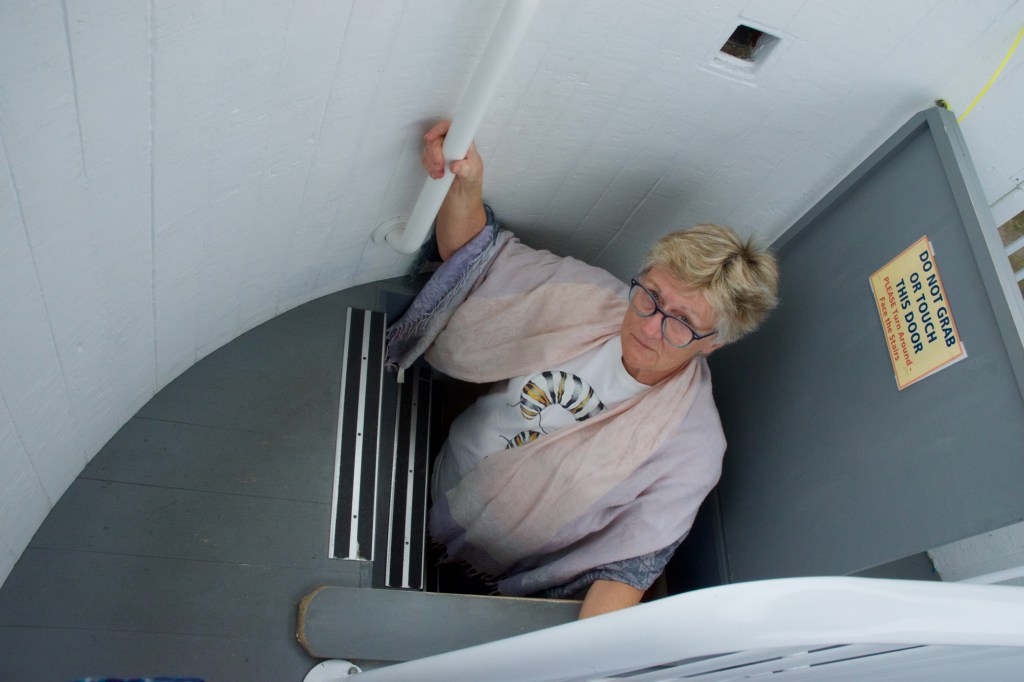
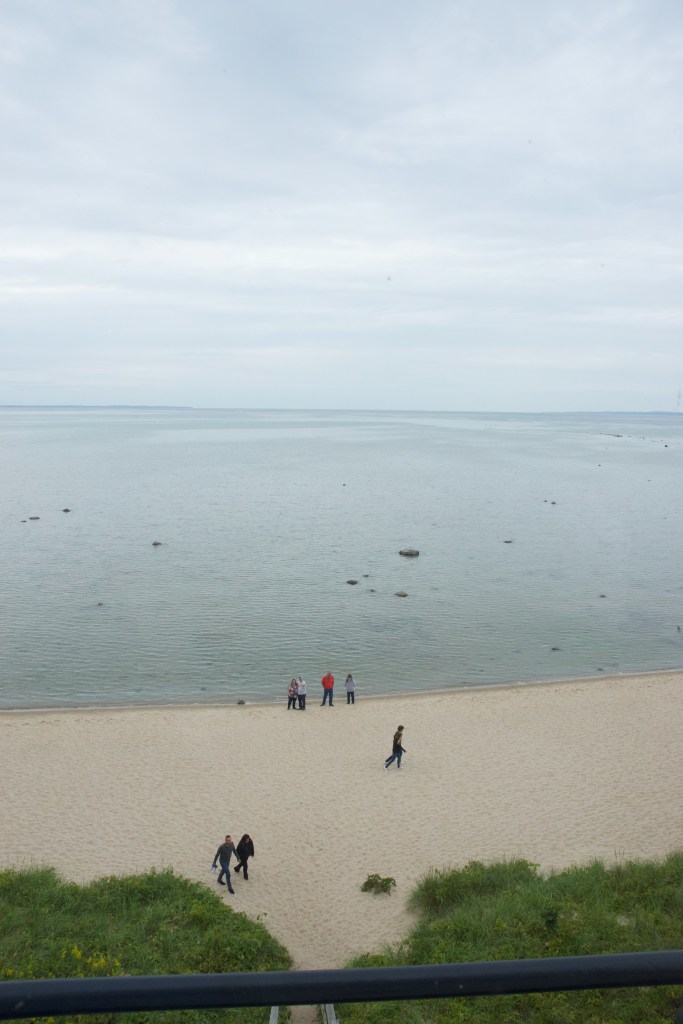
This is the 5th-order Fresnel lens used by the Mission Point Lighthouse. It weighs about 110 pounds, assembled.Sarah Lane served about 25 years as the lighthouse keeper at Old Mission. For part of that it was an unofficial role during his illness, but she became the official keeper after his death. The documentation in her restored quarters on the second floor does not identify the quilt pattern, but Vicki sees in it a stylized lighthouse lens, which I think is pretty cool.Vicki was captivated by the button decorations on this quilt at the Old Mission Lighthouse. She and the docent believe the buttons are just thread sewn into a button.It was a grey day when we visited, but visibility was still good. We agree that the trees would have not been allowed to get this big back when the lighthouse was in operation.Those steps are among the steepest that we have encountered in our visits to lighthouses. At least the handrails were in a good spot. The keepers would have climbed these steps every four hours to trim the wicks, every night.Silly me, I kept wondering what it would look like when the tide came in. There isn’t much of a tide on the great lakes, regardless of how huge the lakes are. But these rocks are part of the shoals that the lighthouse had to guard against.
The grounds of the lighthouse also contain the Hessler Log House, saved from destruction in the 1990s and restored and refurbished and moved to this site from further down the peninsula.
It’s an early version of today’s tiny homes.
The Hessler Log House stands on the grounds of the Mission Point Lighthouse. It was built in the mid 1850s by Mary and Joseph Hessler.Threatened with demolition in the 1990s, the Hessler Log House was saved and moved to the lighthouse site as a tribute to the pioneers of the Old Mission Peninsula.The dovetail joints that hold the Hessler House together are still visible, if somewhat obscured by the grouting or cement used in the reconstruction.




 Two Sheeps to the Wind