The war memorial at the Johnson County Courthouse has a name I know, but he’s someone I never met. It lists him with the fallen of World War II, but that isn’t quite right. He survived that war.
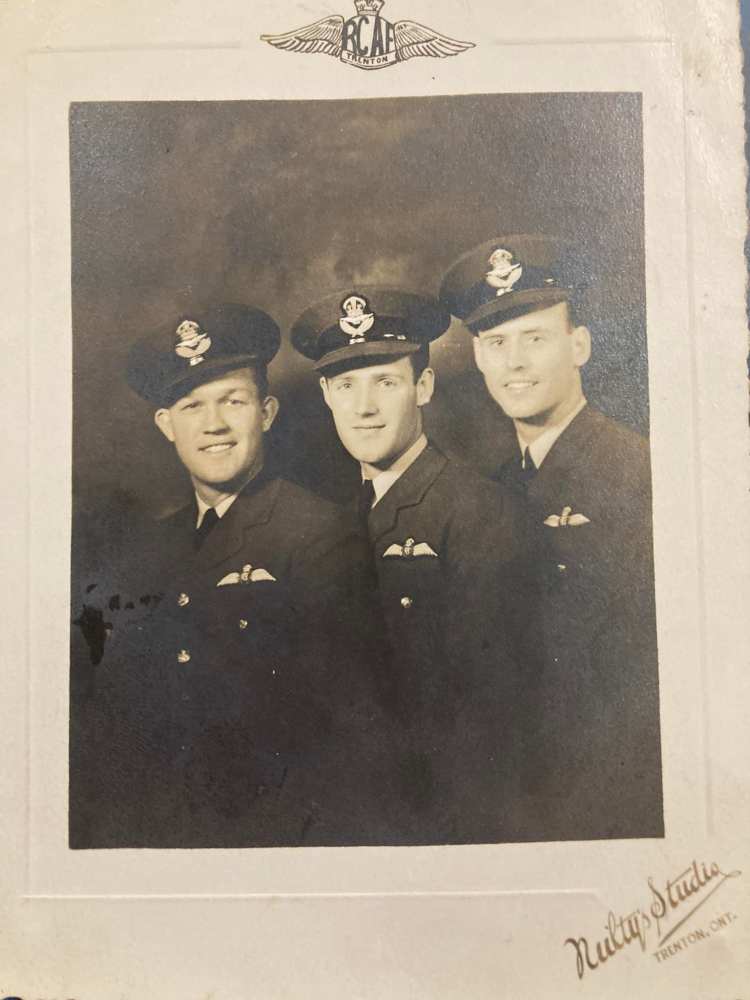
As I was growing up, I was fascinated by the career and the family stories and photos of my first cousin, Morris Hall Watkins, Captain, USAF, former flight officer, Royal Canadian Air Force.
The coolest story comes from a newspaper clipping about a dogfight in which he was chasing one Luftwaffe plane and being chased by another. The plane he was pursuing went down in flames, but when he returned to base they found his guns had jammed right after takeoff. No credit for that one. Apparently the pilot chasing my cousin missed him and shot down the plane in front. “Chalk that one up to Hermann Goering,” the article quotes Watkins as saying, referring, of course, to the Nazi head of the Luftwaffe.
Those words could have come from the typewriter of a public relations officer, but I suspect they are legit. Another of the memorabilia that my mother and aunt had was an essay he wrote while at the College of the Ozarks. I forget what the actual assignment was, probably Shakespeare, but he started off with a film noir vibe about a circle of light highlighting the “weapon” on a white sheet, or something like that. He was talking about writer’s block, and the light was his desk lamp, the weapon his ink pen, and the white sheet the blank piece of paper calling out for the flow of words. I count that as pretty creative.
Morris Hall, as my mother would call him, or “Morrie,” as his pilot mates would call him, acted on his wish to fly in the opening days of World War II.
It wasn’t Pearl Harbor but the start of Britain’s war with Germany that led him to Canada to join the Royal Canadian Air Force and become a pilot, possibly an instructor for other pilots as well. When the United States entered the war, the USAAF paid Canada for his training and he became a fighter pilot, flying the P-40 in northern Africa.
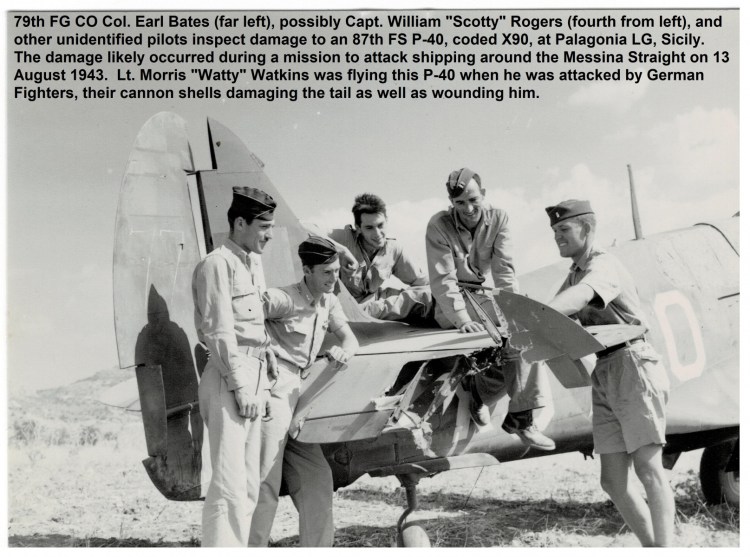
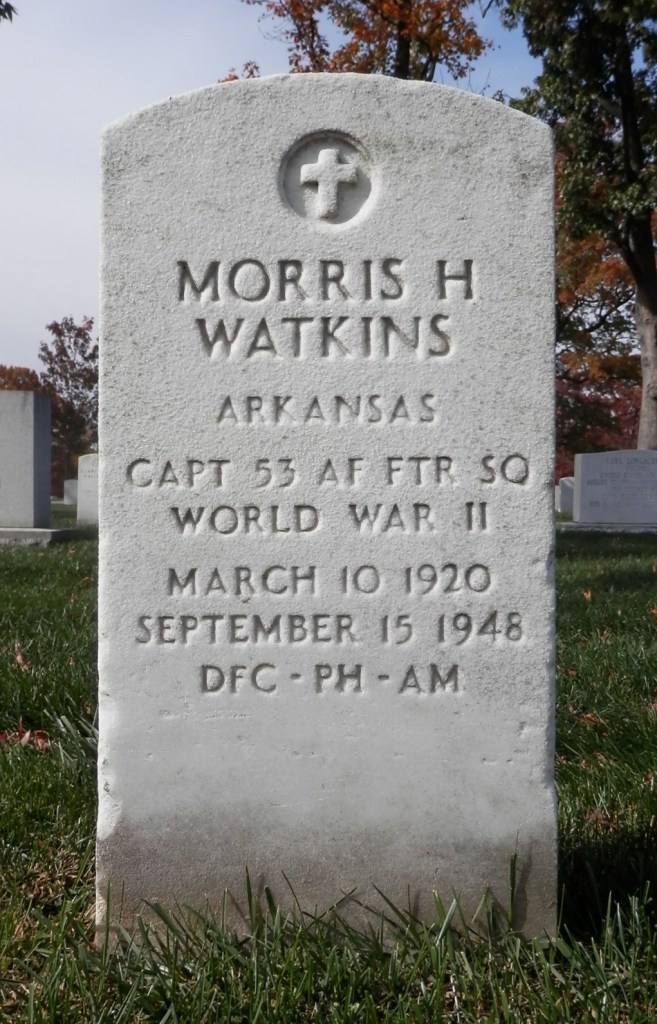
However, while cruising the Internet during my research today, I found a link to a treasure box. On the findagrave site with my cousin’s gravestone in Arlington National Cemetery, I found that someone had left a note referring to the 87th Fighter Squadron of the 79th Fighter Group. I recognized the “skeeter” patch of the 87th. Following that link (https://79thfightergroup.com/87th-fighter-squadron-pilot-roster) led to many photos I had never seen and to the records of his service with that squadron. He had 81 missions in Africa, Italy and probably southern France, and he is noted to have received the Purple Heart, the Air Medal and eight Oak Leaf Clusters. I know he also received a Distinguished Flying Cross, but the 87th did not mention that.
The site also gives a good indication that he shifted, with his squadron, to the P-47 Thunderbolt in the latter part of the war. The P-47 was first a fighter, but it saw a lot of action as a ground attack aircraft, essentially filling the role of the modern A-10.
There are also photos there, several of which say he went by the nickname of “Watty” Watkins at that time. News to me.
There are days that I just love the Internet. This is one of them.
After the war, Morris Hall was assigned to the 53rd Fighter Squadron, based in the Panama Canal Zone. He began flying the F-80 Shooting Star, the first operational jet fighter used by the United States.
The 53rd was sent to Germany after the Cold War developed and the Soviets began the Berlin Blockade, leading to the allied airlift of food and fuel to those trapped in West Berlin. (Another relative was a pilot of one of those cargo planes that took supplies to Berlin, but that’s a story for another time.)
In September 1948, Capt. Watkins was killed in a crash during a training mission out of the Furstenfeldbruk Air Base in southern Germany.
I can’t find anywhere that he is listed as one of the 31 American casualties of Operation Vittles, the U.S. portion of the airlift, but then he was not directly involved in the flights into Berlin. Even so, he was training in support of the airlift.
This was a tense time in the Cold War. The Soviets had blocked roads and rivers leading to the American, British and French Sectors of West Berlin. Only three air corridors remained open, and the airlift took more than 2 million pounds of food and fuel to the city.
It could have turned into a shooting war. Had that happened, Watty Watkins would have been on the front line. His base near Munich is only a one-hour airline flight from Berlin in a modern Airbus A-321. An F-80 Shooting Star, with a maximum airspeed of more than 500 miles an hour, could be there in much less time.
But war didn’t break out. West Berlin survived. And my cousin died.
He was only 28, and he left a wife and two small children.
As a child and teenager, I would often try to imagine the life he might have lived. I still do, for that matter. When I was a child, he seemed so old and so distant in time. From my perspective today, he was so incredibly young when his life was cut short.
Here’s to you, Watty.
 Two Sheeps to the Wind
Interesting but sad story. May this hero rest in peace.
LikeLike
Iâm not seeing the post.
>
LikeLike